
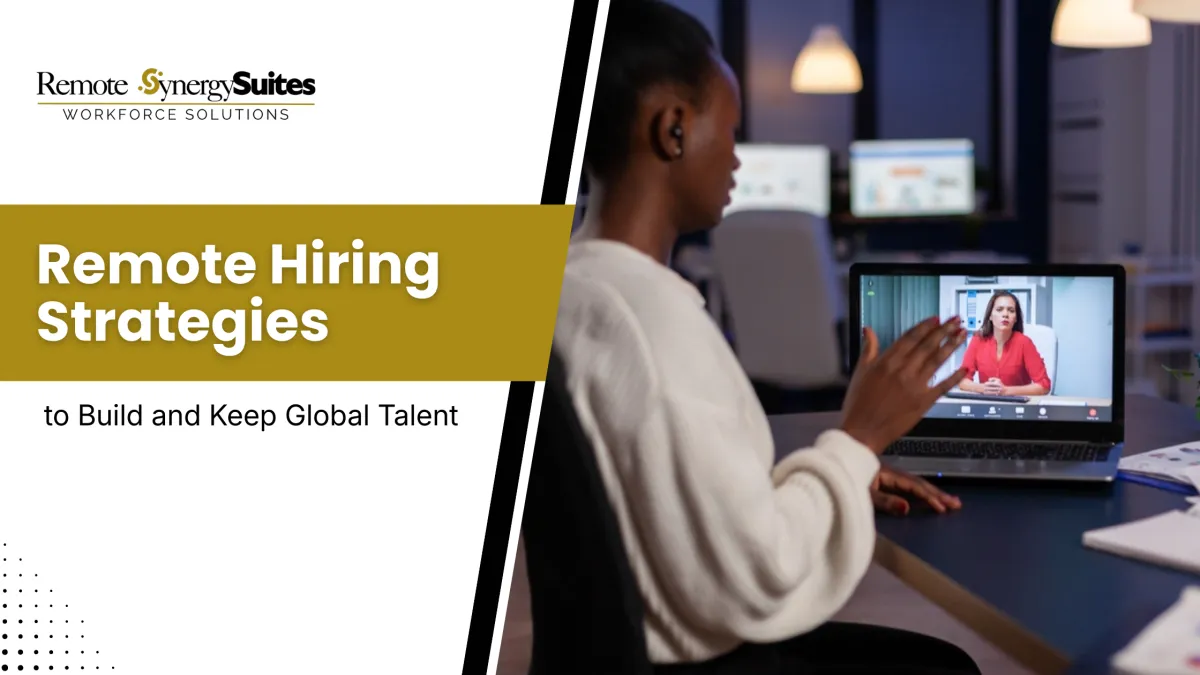
Remote Hiring Strategies to Build and Keep Global Talent
Remote hiring strategies are what separate businesses that grow with strong global teams from those that cycle through candidates and never quite get it right. Many founders spend real time and money on recruiting, only to end up with hires who need constant direction, miss deadlines, or leave within a few months. The frustrating truth is that the problem is rarely the candidates themselves. It is almost always the absence of a structured system behind the hiring process.
This blog will walk you through how to build remote hiring strategies that attract the right people, assess them accurately, and set them up to stay and perform long-term. Let's start with why most remote hiring falls apart before it even gets going.
Why Most Remote Hiring Strategies Break Down Early
Many businesses treat remote hiring as a slightly adjusted version of traditional office hiring. They post a job description, collect resumes, run a few conversations, and hope the best person shows up. This approach might work when you can coach someone in person every day, but it falls apart in a remote setting where execution depends on clarity, independence, and structure from day one.
The root cause is that most job postings describe tasks instead of outcomes. When candidates are evaluated on whether they seem capable rather than whether they can execute independently, the hire feels right in the interview and breaks down in practice. Successful remote hiring requires a completely different framework from the moment a role is defined to the moment a new hire completes their first 90 days.
Here is where remote hiring strategies most commonly break down:
Job descriptions list duties instead of deliverables: Most postings focus on responsibilities rather than defining the specific outcomes. The role is accountable for, which attracts generalists who are unclear about what success looks like from the start.
There is no consistent evaluation process: Without a shared scoring framework, hiring decisions depend entirely on gut feeling, which leads to inconsistent results and candidates who perform well in interviews but struggle on the job.
Onboarding is treated as an afterthought: Remote hires who do not receive structured onboarding within their first 30 days are far more likely to disengage quickly, underperform, or leave within their first three months.
Culture fit is measured informally: Without deliberate assessment criteria, culture fit becomes a vague, subjective judgment made in a 30-minute video call, which rarely predicts whether someone will thrive in a remote-first environment.
Build a Remote Talent Recruiting System Before You Post a Job
One of the most important shifts in successful remote hiring is moving from ad hoc recruiting to a repeatable remote talent recruiting system. A system means you have defined stages, clear evaluation criteria, scoring tools, and communication templates ready before a single application comes in. Without this foundation, every hire is a one-off experiment rather than a structured process you can learn from and improve over time.
When your recruiting system is built in advance, you also shorten your time to hire and reduce the mental load on your leadership team. Instead of making a series of judgment calls at every stage, your team follows a defined process that consistently surfaces the right candidates.
Define Each Role Around Outcomes
Before writing a job posting, define what success in the role looks like at 30, 60, and 90 days. This outcome-based role definition becomes the foundation for everything else, from how you write the posting to how you evaluate candidates in interviews. When a role is defined clearly, the right candidates self-select in and poor fits self-select out before you spend time reviewing them.
Create a Candidate Scorecard
A candidate scorecard is a simple document that lists the core competencies and outcomes required for the role, each rated on a consistent scale by every interviewer. This single tool removes bias and makes it straightforward to compare candidates fairly across different conversations. It is one of the most underused elements in remote talent recruiting systems and one of the highest-return investments you can make in your hiring process.
Design a Multi-Stage Evaluation Process
Successful remote hiring rarely happens after a single conversation. A well-designed process includes an application screen, an async skills assessment, a structured interview, and a final values conversation, each filtering for a specific quality. By the time you extend an offer, you have real evidence rather than a strong impression. See how the Recruitment Track inside Synergy OS builds role clarity and hiring systems from the ground up.
The Skills for Remote Workers That Actually Predict Success
Not every talented professional is set up to succeed in a remote environment. The technical skills that make someone great in an office do not automatically carry over to distributed work. When building your remote hiring strategies, the skills for remote workers you screen for need to go beyond job-specific abilities and include the behavioral qualities that predict whether someone will actually thrive without daily in-person oversight.
The good news is that these skills can be assessed directly through a well-designed application and an async evaluation process. A short work sample or structured writing exercise will tell you far more about a candidate's remote readiness than any traditional interview question ever could.
Here are the skills for remote workers that matter most:
Async communication ability: The candidate should be able to write clearly, summarize information concisely, and communicate progress or blockers without needing real-time clarification or prompting from their manager at each step.
Self-directed task management: Look for evidence that the candidate can break goals into daily actions, prioritize their own work, and deliver results consistently without being told what to do next on every project or task.
Comfort with documentation: Remote workers who resist documenting their work create knowledge gaps that slow teams down; strong hires actively contribute to shared systems and keep records updated without being asked to do so.
Accountability without supervision: The best remote candidates have a clear track record of owning outcomes, communicating honestly when things go off track, and course-correcting on their own rather than waiting for a manager to step in.
Adaptability to tools and systems: Candidates who learn new platforms quickly and follow structured workflows without friction are far more likely to integrate well into a remote-first environment built around a defined Recruiting OS.
Use AI-Enabled Hiring to Find Better Candidates
AI-enabled hiring is changing how remote-first businesses attract and evaluate global talent. From intelligent job distribution to automated resume screening and async video assessments, the right AI tools can reduce the time spent on early-stage filtering while improving the quality of candidates who reach your interview stage. The key is using AI to strengthen your existing process rather than replacing the human judgment that matters most at the final stages.
AI for Job Posting and Candidate Sourcing
AI writing tools help you create clear, outcome-focused job descriptions that attract strong candidates and filter out poor fits before they apply. Platforms like LinkedIn Recruiter and AI-powered sourcing tools can also identify passive candidates who match your criteria, expanding your reach well beyond active job seekers. This is especially useful for remote talent recruiting systems that need to reach global talent pools across multiple time zones and regions.
Async Video and Skills Assessments
Tools like Spark Hire or HireVue allow candidates to complete video interviews and skills assessments on their own schedule, which works well for hiring across time zones. These platforms also provide structured data on response quality and consistency, giving your team something concrete to evaluate rather than relying on impressions from a single live conversation. For remote hiring strategies focused on execution capacity, this stage often reveals more than any other part of the process.
Keeping the Human Element in AI-Enabled Hiring
AI should filter, not decide. The final stages of any successful remote hire should include direct human conversation, a clear values assessment, and a genuine read on whether the person is both a cultural and operational fit for your team. According to SHRM, organizations that combine structured AI screening with human-led final conversations consistently report a higher quality of hire than those relying on either approach alone.
How to Run a Structured Interview and Evaluation Process
A structured interview process is one of the clearest signs of a mature remote talent recruiting system. Structured interviews use consistent, pre-written questions tied to the competencies on your candidate scorecard, and every person interviewing for the same role answers the same questions.
Unstructured interviews feel more natural but are far less reliable at predicting how someone will actually perform. Research from Google's re:Work confirms that structured interviews outperform unstructured ones in predicting real-world job performance.
Here is how to build and run a structured interview process for remote roles:
Write role-specific interview questions before any conversation begins: Each question should connect directly to a competency on your scorecard, and every interviewer should use the same question set so that candidate comparisons are fair and based on consistent data.
Use the STAR format to guide candidate responses: Asking candidates to walk through a Situation, Task, Action, and Result from their own experience gives you concrete behavioral evidence, which is the strongest predictor of future performance in a remote setting.
Score independently before any team debrief conversation: Each interviewer should complete their scorecard before coming together to discuss, which prevents groupthink and ensures that every perspective contributes to the final decision equally.
Include an async work sample somewhere in your process: Asking candidates to complete a short task that reflects real work they would do in the role reveals more about their execution capacity and communication style than almost any interview question can.
Retain Global Talent Through Operational Clarity
Once you have hired well, the work does not stop. Retention in remote teams is directly connected to how well your operational systems support the people inside them. Remote employees who join a business without clear workflows, defined role expectations, and structured onboarding are far more likely to disengage and leave, regardless of how much they wanted the role when they accepted the offer.
Successful remote hiring extends well beyond the offer letter. It continues through the first 90 days, where structured onboarding, clear outcome ownership, and regular check-ins determine whether a new hire becomes a long-term contributor or an expensive replacement. Businesses that build operational infrastructure before they hire retain talent because their team members always know what they are responsible for and where to turn when they need support.
Remote Synergy Suites models this approach by building the systems that make retention possible before a hire ever joins the team. When a Recruiting OS is paired with a clear operational foundation, including documented workflows, outcome-based accountability, and team communication rhythms, the business becomes a place where talented remote
professionals can grow and stay. Retention is not a perks strategy. It is an operational one. Explore how Remote Synergy Suites builds hiring and retention infrastructure through the Recruitment Track.
Parting Words
Remote hiring strategies only work when they are built on structure, not instinct. From creating a recruiting system and assessing the right skills for remote workers to using AI-enabled tools and running structured interviews, every step in this guide brings you closer to a global team that executes well and stays. The right hires, placed inside the right systems, are how remote businesses scale without constantly starting over.
Remote Synergy Suites can help you build the hiring and retention systems your growing business needs today.
FAQs
Q1: What are remote hiring strategies and why are they important?
Remote hiring strategies are structured approaches businesses use to attract, evaluate, and retain talent in a distributed work environment. Unlike traditional hiring, remote hiring requires clear role definitions, structured evaluation processes, and strong onboarding systems to ensure candidates can work independently and collaborate effectively across time zones.
Q2: What skills should companies look for when hiring remote workers?
When hiring remote workers, companies should focus on skills that support independent execution. These include strong async communication, self-directed task management, accountability without supervision, comfort with documentation, and the ability to adapt quickly to digital tools and workflows.
Q3: How can businesses build a successful remote talent recruiting system?
A successful remote talent recruiting system includes clearly defined role outcomes, candidate scorecards, multi-stage evaluation processes, and structured interviews. By creating a repeatable system instead of relying on ad-hoc hiring decisions, businesses can consistently identify candidates who are capable of performing well in remote environments.
Q4: How does AI-enabled hiring improve remote recruiting?
AI-enabled hiring tools help businesses automate early-stage recruiting tasks such as job distribution, resume screening, and async interview scheduling. This allows hiring teams to focus their time on evaluating candidate quality and cultural fit while AI improves efficiency and expands access to global talent pools.
Q5: How can companies retain global remote talent after hiring?
Retention of remote talent depends heavily on operational clarity. Businesses that provide structured onboarding, clear outcome-based roles, documented workflows, and consistent communication rhythms create environments where remote employees can perform confidently and stay long-term.



